Showing posts with label Birds Knowledge. Show all posts

Sunday, March 3, 2019

How to Take Care of Mounded Lovebird to Quickly Finish

How to Take Care of Mounded Lovebird to Quickly Finish


In carrying out chirping birds, especially lovebird birds, of course in doing their treatment different from the condition of the bird itself, such as lovebird puppies or balibu, the marriage process, train the chirping sound until the time of moult.

In its care, of course, for lovebird owners, they are eager to have a good long-lasting quality to have on their favorite lovebird, but when they get it, don't just stop, but how to maintain the quality of the chirp and also improve the sound quality of the chirping.

However, when the bird has a good chirp, of course when the mabung process takes place it will certainly make it lazy to sing and choose to keep quiet a lot.

However, for lovebird bird owners, there is no need to worry about their birds rarely singing when moult, because this is a scientific thing that will happen to lovebird birds who are mingling.

With a lot of silence and rarely singing, it is certainly a good thing, because when birds are in a state of moult, it is not good for the moult process. And one of the lovebird is still diligent in singing during mabung, meaning lovebird is in a state of lust. Therefore, it is important to maintain the condition of lovebird lust to be stable, so that the moult process is not interrupted and fur growth becomes slow.

How to Take Care of Mounded Lovebird to Get it Quickly Done


In every lovebird treatment, as mentioned above, it must be differentiated according to various things, such as in the moult process, so that the moult process becomes perfect, as it should.


1.Don't hang out


In conditions not moult, the lovebird can be dried every day, which is adjusted to the condition of the bird, can be once a day or 2 times a day. However, when birds are in a state of mourning, it is best to avoid drying it, because it can affect the quality of their feathers when they grow back and the moult process will last longer than they should.

In addition, by drying lovebird during moult, it will make the moisture of bird feathers dry. Even though moist bird feathers can make the hair removal process work properly.

2.Extracting


Giving the extracting can be given to lovebird while the mabung process will be finished, but it is recommended to give extrafooding to lovebird the completion of the moult process.

 
Feeds that can be given to lovebird during mabung include, such as sweet corn, cucumber and kale. But not too much feeding, because it is worried that birds will become lust. The feeding of the extracting food has a role to help the process of mooring and also the growth of the hair is nourished from the feed, so that it grows well.

3.Avoid bathing it


Although lovebird at the time of moult requires moisture to stay awake, but to avoid bathing it, because it can make lovebird feathers tough and also inhibit the moult process.

Bathe the lovebird when the bird's feathers begin to grow back which is marked with needle feathers that begin to grow around the body.

4.Krodong

When bird feathers begin to fall out, body temperature is greatly affected by environmental conditions because the fur that protects it from falling out and makes its body temperature need protection by using krodong to layered.

Using krodong means that it has benefits that can maintain normal body temperature or help warm body temperature.

However, at any time while mengrodong lovebird, it can store it in a place that has a gentle breeze, to make it comfortable. Or it could be by opening the krodong once in a while in the morning and evening.

5.Give peace

Whatever the type of birds chirping, when the process of moult, it is very important to get ketengan so as not to make it feel disturbed and also stressed. Because when lovebird becomes stressful when moult, it will disrupt the moult process.

6.Bird and Cage Cleanliness

Maintaining the cleanliness of the cage is very important to do, whether it's when lovebird is not mingling and even more so when saving. Because by keeping the cages and birds clean, they will avoid various kinds of diseases, such as microbes, parasites and fleas that might attack lovebird skins that are moult.

By doing the steps mentioned above about how to treat lovebird mabung, hopefully the moult process can run properly and the fur will grow strong and shiny.

Monday, February 25, 2019

How To Take Care Of Sury Starlings That Are Fast For Quick Completion

How To Take Care Of Sury Starlings That Are Fast For Quick Completion


Moulting or commonly referred to as mabung is a common thing that happens to pet birds, including occurring in starlings suren.

Things that usually occur in birds that are mingling include, where birds will experience rarely to sing and also lazy to be active, and sometimes become a separate question from the beginner kicaumania "is this okay?" the question mark itself.

However, it is certain that mabung will occur in starlings suren, and become the characteristics of the starfish surfer mabung marked with lazy birds singing and active fingers than usual.

This is indeed a scientific thing, where birds only focus on the moult process itself so that it can run smoothly as it should, to save energy so that the mouting process becomes smooth. Because if birds become active and are also diligent in singing, it can actually make the bird become obstructed by the moult process.

Mabung Constraints Are Not Running Well

There are a number of possibilities that will occur when birds cannot run smoothly in their moult process, such as:

Falling Failure

Traffic congestion or moult failure is a moult process that occurs when the period of moult, which should be finished is wrong

Save too long

This process can certainly be detrimental to the bird itself, because mabung or nyulam is too long and continues to exceed than it should

Fur Quality is not good

Incomplete mingling can turn the quality of new feathers that begin to grow poorly, feathers easily damaged, curly and also dry.

How to Take Care of Moult Surroundings to Quickly Finish

 In the treatment of suren starlings that are moult, things must be done so that the moult process is smooth as it should be, so that the moult process becomes inhibited which can cause negative things as mentioned above.

Store in a damp place

A good environment so that the moult process runs well, it can store birds in a humid place, and avoid storing wild birds that are buried in a hot place or stored in the sun. Because to keep the temperature of the starlings body moist, it will help the process of breaking down the hair to be better.

Drying at any time

Even though birds need enough moisture to help in shedding their fur, they can occasionally remove it for 10 to 20 minutes to remove lice or mites that might stick to suren starlings that are milling.

Keep clean

Clean the cage regularly 2 times a week to avoid the appearance of bacteria, germs or mites that stick to the bird's whistle so that it can damage the fur and when the fur begins to dense, it will not be perfect because it has been damaged by mites.

Don't bathe

Bathing the starlings when moult will make the threshing process imperfect because it becomes tough, but if you want to bathe it wait until the needle feathers start to grow a lot on the skin.

Feeding

Giving food, can be done by adding portions, to maintain stamina and help the moult process, so it can be nourished by the need for fur to grow back. If the bias is to provide 3-tailed cricket feed, then you can add as many as 5 to 6 tails every day and give additional feed in the form of earthworms.

Masteran

When starlings surrender, then usually there will be a lot of silence and relax in the cage and lazy to sing. By utilizing mabung conditions, it is certainly very good to master, so that birds can improve the quality of their singing.

To download the master voice of starling suren can by downloading the sound of starlings suren on this page, Download the sound of starlings Suren.

Don't give supplementation

If the starlings are usually fed in the form of supplements to make them gacor, then at the time of moult the supplement is stopped, because by feeding from these supplements can make the bird become lust and the moult process becomes disrupted and becomes obstructed.

Multivitmin

If you want to use supplements, you should use a multivitamin specifically for bird moulting, so that the moult process is smooth. and you can buy it at a bird stall or in an online store that sells Mutivitamins for moult.

Keep away from the sound of high volume birds

To increase the comfort of birds, then you should keep them away from birds that have loud sounds, such as the sound of birds and the sounds of other birds that have a loud voice, because it can make the birds who are enjoying being disturbed.

Monday, February 18, 2019

10 Different Bird Species with Most Interesting Appearance and Features

10 Different Bird Species with Most Interesting Appearance and Features


Birds are hairy, winged, warm, egg-breeding, vertebrate animals. The budgerigars we feed at least once in our house are just one of the species we all love.

However, with about 10,000 living species, birds form the most crowded vertebrates. From the North Pole to the South Pole, they live everywhere in the world. The size of the bee varies from 5 to 5 cm in the hummingbird and up to 2.7 m in the ostrich. According to fossils found, birds come from dinosaurs about 150-200 million years ago. The first known bird lived about 155-150 million years ago.

Birds, unlike other living realms have some features. They are the first constant temperature organisms. In particular, all of its members are covered with feathers that are not seen in any other group of animals. There are advanced sound boxes. They lay hard-shell eggs and incubate. Birds are fully functioning, complex and advanced, body systems.

Here is the  10 bird species that surprises us with its features and looks!

1. Peacock

It is not the start of the bird and the colors, the Peacock.

It is the name given to two types of birds in the genus Pavo. During the courtship period, the male peacock is known for opening his tail. The female peacock has a bright green neck and the body is brown or grayscale brown. The sound of the male peacock's tail doesn't sound good at all. But these peacocks are not prevented from being seen as sacred in many religions.
 
A peacock has been a bird in many different cultures and religions since ancient times. The story of the goddess Hera in ancient Greece as a symbol of the peacock is interesting. According to the story, when the very giant Argos, who served the goddess, was killed by Hermes, the goddess laid her eyes on the tail of the peacock. Peacocks, which have a place in the belief of Ezidism, are the symbol of Angel-God created by God Azda and given the task of creating the universe and people. In Islam, this animal, which is identified with good concepts such as abundance, happiness and prosperity, has a place in many cultures.

2. Bee Bird

Bee and insects are fed with a migratory bird, bee bird, attracts attention with its agile movement ability. There are 24 species of bee birds, a colorful relative of sea birds.

These birds, which live in temperate and tropical areas in the eastern hemisphere, are common in both open areas and forests. The front fingers of the feet of the bee birds are adherent. The downward-curled beak is long and pointed.

Bee birds, which can be fed with many insects, prey on honey bees and wasps. Therefore, beekeepers do not like these unique looking birds. The most striking feature of the bee-eater is that they catch insects flying in the air. During this time they either fly or they hunt for a short flight. Bees or bees that want to eat 225 bees every day, bee birds attract attention with their unique feather colors.

3. A Famous Bird

Hoopoe

Uniquely attracted by the beauty of the bird, the bird also reflects a different beauty with its character. His devotion to his wife is very dependent on the families of hoopoe birds who are not looking for a new wife after his wife dies. When they grow old, the parents are emotional animals who gather their parents' food for them and carry it in their head until the mother finds a suitable place when she dies. For this reason the hoopoe are associated with the sense of mother-reverence in many religions.

This bird living in woodland and vineyards settles in open forests, pine forests or deciduous forests, orchards and vineyards. It can be found on open terrain and can also be found in city parks.

The nymphs that nest in all kinds of cavities and in the cavern, communicate well with people, feed on insects, insects, insect larvae, snails and worms. It is possible to say that the hoopoe, who likes to catch the worms with their long beaks and the earth, throws the worms into the air and opens their beak in the air.

4. Red-billed toucan

The most striking part of these birds living in the tropical forests of South America is their beaks. These birds are red, the body is blue, orange and green. These animals, which are as strong as they are with their big beak, strong feet, short and rounded wings, owe their power to the fruits they consume abundantly. The most important feature of these beaks is that although they are very strong, they are surprisingly light. Moreover, the beaks of toucans not only come to the forefront with their color and power, but also a very strange one, and surprising those who hear it.

Scientists have proven that the toucans are refreshing themselves using their beaks. Understand the toucan birds in tropical climates with their beaks.

It is possible to say that the toucans are a little lethargic in addition to all these features. These birds, who do not like to fly, spend most of their days sitting on the branches and consume lots of fruit.

5. Yakut Throat Hummingbird

Here is the fastest wing multiplier bird in the world! Ruby-throated hummingbird that can flutter 55 times per second is a complete record holder. In the mating period, hummingbirds reached 200 wings, thus they managed to enter the Guinness Book of Records.

Hummingbirds men are smaller than females and have a slightly short beak. These birds, who shed their feathers once a year, begin to pour their first feathers during the autumn migration.
 
Adults of this species typically only come together to mate. They become aggressive to protect the area they feed. Because of their small size, they are vulnerable to insect-eating birds and animals. The nectars of flowers and flowering trees are the main food, and they occasionally consume insects and tree juice from the holes in the trees. Young birds feed on insects to get nectar as well as protein.

6. Ruppell Griffon Vulture

Endangered Red Vultures are the highest flying birds ever recorded. These birds can reach 37 thousand feet high.

This altitude is a point where the airplanes can escape and because of the lack of oxygen the human cannot escape. You will understand that these birds' circulation systems and internal pressure regulation mechanisms are quite developed. Hemoglobin, which is in the blood of these birds, produces oxygen at this altitude, so there are no problems.

7. Bird of Paradise

Their homeland is the southern regions of Africa. There are 42 species in the genus of bird of paradise family 15. Members of this family are best known for having men's sexual dimorphism properties, ie, very long and elaborate hairs, particularly from the beak, wings, tail, or over. Mostly they live in dense rainforest. The diet of all species includes fruits and, to a lesser extent, arthropods. The birds of paradise have mating systems ranging from monogamy to polygamy.

The number of species is endangered by the loss of hunting and habitat.

The second, and also if their psychology deteriorates, then we are upset because these birds send their feathers when their psychology deteriorates.

8. Kakadu

Cockatoo; They can live up to 120 years! Of course this figure is quite the exception. The beak force of a kakadun is almost identical to the force of a dog's jaw!

Most of these seventeen species of parrots are white, some of them are black, with red or yellow colors sprinkled on their bodies. Their bended and sturdy beaks serve to break down nuts, find roots, or hunt insect larvae under the bark. Worm-like languages ​​help feed.

Kakadular lives on the treetops and is housed in tree hollows. They can be harassed by looting the field crops in noisy large flocks.

Cockatoo can make a wide variety of sounds. Whistles and telephone ringing can imitate sounds like human voices. Those who have the ability to speak well are rare.

9. Flamingo

One of the most fashionable animals of recent times is flamingos. I hear you say what kind of animal fashion you might be. However, flamingos, which we started to see on many products from textile products to stationery materials, are very common in recent times.

The flamingos that gather their long and curved necks on long and thin legs and their striking colors are very talented. One of its distinctive features is the presence of a curled beak and the upper part of it, which serves as a filter while removing food from water or mud. The red shades of hair vary according to the amount of carotene they contain. Young birds in captivity have white feathers because they have very little carotene food.

The number of flamingos, which sometimes have a million numbers, are monogamous. Their name comes from Portuguese and Spanish and means Fire.

10. Red Makaw Macaw

Red macaw is one of the most beautiful and biggest members of the macaw family. They live in humid, evergreen forests in Central and South America. They are famous for their colorful feathers. It has blue ridges and bright red hairs. The upper wings are yellow and green in color.

Their strong, curved beak is the first striking feature of these birds. An adult red macaw parrot has a length of 80-90 cm and a weight of up to 1.5 kg. Red macaws, which can reach up to 35 mph while flying, live quite long. They have an average life of 40-50 years. Captured red macaws are said to survive up to 75 years.

Birds, known as the smartest birds in the world, can easily learn many words, sounds and tricks. Very well-trained red macaw parrots are said to distinguish even the colors and shapes.

Red macaws are very noisy parrots. They produce different tones like screeches and squawks. There is a dietary diet consisting mainly of peanuts, seeds, fruit and insects. Can easily break the nuts with strong curved beaks

Thursday, February 7, 2019

10 Smallest Birds in the World

10 Smallest Birds in the World


Birds are small, funny, and can fly animals. There are many types of birds of different sizes. There are small ones, some big

ones. On this occasion, let's discuss the types of birds that have relatively small bodies. What is the smallest bird in the

world like? Check out more below.

1. Crimson Chat - 10-13 cm


This cute little bird is Crimson Chat. Birds that are often found if you are in Australia. This bird is known to only have a

size of 10 to 13 cm, making it the smallest bird in the most distended order in the list. The weight of this bird is also

very light, only about 10 grams.

This small bird has the characteristics of long legs and a slightly bent down beak. Crimson Chat's main food menus are small

insects, spiders, nectar, and seeds. Despite its small size, the Crimson Chat bird is a very noisy and agile bird. These

birds will usually enter the laying season in August to November.

2. Tropical Parula - 11 cm


Tropical Parula is found in the Amazon basin. The Amazon basin is still an area that is still part of South America which is

fed by the Amazon River. Tropical Parula has a body size of only 11 cm and weighs only about 6 grams. Especially for Tropical

Parula males, they have a blue-gray head color.

Tropical Parula itself can still be divided into 14 species. Only certain species have very small bodies that are included in

this list. Tropical Parula has a sharp but small beak. This beak is useful for finding prey. Most species Tropical Parula are

carnivorous birds, their food is like spiders and insects, sometimes they also eat seeds and nectar.

3. Bananaquit - 9.5-11 cm


In the West Indies, the Caribbean Islands and the southern part of Brazil there is one species that has a very small size.

The bird is Bananaquit. These small birds include very social birds, they are very often and easily found near flowers and

fruit gardens because that's where they used to find food.

Bananaquit has the characteristics of upper fur which is dark gray and the bottom is yellow. The curved shape of the beak

aims to suck the nectar from the flower. Bananaquit has a body of about 9.5 to 11 cm and weighs only 9 grams. When entering

the mating season, Bananaquit birds usually only produce 2-4 eggs.

4. American Goldfinch - 11 cm


With a body ranging from 11 cm, the American Goldfinch bird is the smallest bird in the world at number 7. American Goldfinch

is one type of finch found in North America, Canada and Northern Mexico. When summer arrives, American Goldfinc is male, the

color of his body will turn yellow, the wings and head turn black. Unique huh?

 American Goldfinch body hair will fall out 2 times a year, which is at the end of winter and mid-summer. American Goldfinch

is a vegetarian bird, which is why the age of this bird can reach 10 years. Once laying eggs, American Goldfinch will usually

produce 2-7 eggs.

5. Brown Gerygone - 10 cm


Brown Gerygone or commonly known as Brown Warbler, is a type of Passerine bird that is native to the coast of Australia. The

top part of Brown Gerygone has a tawny-gray or brownish-yellow color. The face and lower body parts have a dark color and

slightly white spots.

This bird is the smallest bird in the world because its body size is only 10 cm and weighs only 5 grams. Although the total

bird population has yet to be revealed, the Gerygone Brown bird population is of concern. These birds are often seen flying

in small groups, 2 or 4 birds. Their main food menu is insects.

6. Goldcrest - 8.5-9.5 cm


The smallest bird in the next list is the Goldcrest bird. Goldcrest is found in many different locations such as in Asia,

Europe, England, Wales, China, Russia, and the Himalayas. Included in the type of Kinglet, Goldcrest only has a body between

8.5 to 9.5 cm.

Goldcrest birds are colored birds. The yellow plumage of her chest makes her called Goldcrest nicknamed the King of Birds in

fairy tales in Europe. Goldcrest has green upper feathers, white lower feathers, and white on the wings.

7. Golden Head Cisticola - 10 cm


The Cisticola Golden Head is found in Western Australia, India and China. The Golden Headed Cisticola is one of the types of

Warbler birds found in India to Australia. For places that are experiencing vegetation or wetness, the Cisticola Golden Head

bird will definitely approach the place.

The Golden Headed Cisticola's body size is 10 cm and weighs 10 grams. This little bird has a menu of small insect foods and

seeds. When in marriage, both male and female birds will both build their nest. Golden Headed Cisticola builds their nests

from spider webs.

8. Pardalote - 9-11 cm


This small but very beautiful bird has a very beautiful color. Pardalote usually lives in small groups and lives in tunnels

or in tree holes. Their main food menu is insects, spiders, and lerp (honey dew which crystallizes produced by insect

larvae).

This small Pardalote only has a body size of 9 to 11 cm and weighs around 9 to 11 grams. Male and female Pardalote birds work

together in making nests, incubating eggs, and feeding their children. This Pardalote bird is a native bird from Australia.

9. Weebill - 8-9 cm


At number 2 in the list of the smallest birds in the world are Weebill birds. This bird only measures 8 to 9 cm, weighing

around 6 grams. Weebill is found on the continent of Australia. Most of the time, Weebill uses it to hunt insects and larvae

in wood and trees.

Weebill has the characteristics of a bright yellow body with a gray beak, sweet chocolate, yellow eyes, and gray feet. When

the spawning season arrives, female Weebill birds usually only produce 2 to 3 eggs. The Weebill bird population has now

entered an alarming level.

10. Bee hummingbird - 5-6 cm


You certainly can imagine how small a bird that is only 5 to 6 cm in size isn't it? Well, that's the average size of a Bee

Hummingbird. This Bee Hummingbird is the winner in the list of the smallest birds in the world. That small body is what makes

this bird's weight so light, 1.6 to 1.8 grams.

The male Bee Hummingbird has a green and red color on the neck. Male birds also have a smaller body size than female birds.

Female birds have green and white upper body colors at the bottom. Bee Hummingbird is commonly found in Cuban forests.

Females usually only lay 2 eggs.

Wednesday, February 6, 2019

10 Birds That Cannot Fly

10 Birds That Cannot Fly

Birds are vertebrate animals that have feathers and wings. The oldest bird fossil was found in Germany under the name Archeopteryx.

If you hear the word bird, most people will imagine animals or birds that can fly. Indeed for birds, to fly is a very important need to escape from predators.

However, there are a number of bird species that have evolved and lost their flying abilities. They can survive because of their few predators or they have developed other ways to escape and protect themselves.

1. Penguin


Penguins belong to a group of birds that cannot fly but can swim. Live in the south pole, Antarctica. Highly adaptable to life in water, penguins have dark and white feathers, their wings have changed to be more useful as fins when they swim. Most penguins eat from Krill (a type of shrimp), fish, squid and other aquatic animals captured when they swim. They spend half their lives on land and half in water.

Although penguins are birds that are said to only live in the south pole, such as Antarctica. In fact, only a few species of penguins actually live in the southern depths. Some species can be found in warmer regions, and one species such as the Galapagos Penguin can be found close to the equator.

2. Takahe


Takahe or also known as Takahe South Island is an indigenous bird that cannot fly in New Zealand. It was once thought to be extinct after the last 4 specimens were carried in 1898. But after several search efforts, Geoffrey Orbell was rediscovered on Lake Te Anau, Muchison Mountains on November 20, 1948.

Adult Takahe birds have a purplish color with a blend of dark green, where the purple color is the dominant color. Pink feet. The female has a smaller size. This bird is very noisy.

Takahe is included in one of the endangered birds.

3. Ostrich 


Ostrich or known in English, Ostrich. It is the largest bird in the world that cannot fly. This bird is an African native bird. Ostriches are in the same group as Kiwi, Emu, Rhea and Cassowary, namely Struthioniformes. This bird has the shape of a neck and long legs, can run at speeds of up to 70 km / h, spawning the largest eggs compared to other birds.

Of the 5 known Ostrich subspecies, 1 is extinct, 1 is in an endangered condition, 3 are still alive. They live in a group that continues to move, in the group containing 5 to 50 birds. When threatened, Ostriches will lie on the ground or run away. But if it continues to be cornered, it will attack with its strong legs.

4. Cassowary (Cassowary)


Today, there are 3 species of Cassowaries. The most common are South Cassowary, the second and third largest heaviest bird after Camels and Emu. This bird was originally a bird native to the tropical forests of New Guinea, northeast of Australia.

Main foods Cassowaries are fruits, although basically they are omnivores, where they eat from plants, fruits, fungi, invertebrates and small vertebrates. Cassowaries are very shy, if disturbed they will cause very serious injuries. Maybe this is what caused them to enter the list of one of the most dangerous birds in the world.

The Cassowary species initially had 4, 1 of which was extinct and the other 3 were endangered.

5. Rhea


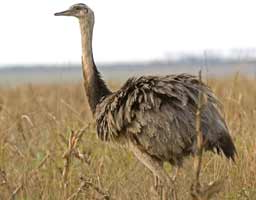
Rhea, a native bird of South America. There are 2 species that are not extinct, namely Greater Rhea or Amerian Rhea and Lesser Rhea or Darwin's Rhea. Rhea is a bird that cannot fly, large, long legs and also has a long neck, resembling a camel. Unlike most birds, Rhea only has 3 toes. They also urinate from a different place from cloaca.

Greater Rhea is a species that prefers open and airy nature, living in grasslands and near waters. Whereas Lesser Rhea will be more often found in bushes, grasslands or even deserts.

6. Emu


Emu is the largest bird in Australia, the second highest bird in the world after the Ostrich. In Australia, there are 3 emu subspecies found on the mainland of Australia. This bird avoids areas that have large populations, dense forests and dry areas.

They have long, thick necks and legs. Emu can also move in a large enough scope and can run up to 70 km / hour. They eat from a variety of plants and insects, but are also known to not eat for a week, and rarely drink. Emu is sometimes found sitting in the water and can also swim, these birds are curious birds, where they will follow things that make them curious.

7. Galapagos Cormorant


Also known as the other name Flightless Cormorant, is the native Galapagos Island as the name suggests. It is one example of the island's extraordinary fauna. He is the only cormorant who has lost his ability to fly.

Like most Cormorants, this bird has legs that are thick and strong to be on the sea, it eats fish, eels, small octopuses, and other small creatures. Even so, they were never more than 100m from the shore.

Because of its number which only reached around 1500 individuals, it is one of the birds that is in a conservation program.

8. Kiwi


Kiwis are birds that cannot fly and are endemic to New Zealand, based on the local size of New Zealand birds, Kiwis are the smallest and produce the smallest eggs related to their size compared to other bird species in the world. Kiwi is a symbol of New Zealand, the association of the term Kiwi is so great that it is known worldwide.

Kiwis are also included in the list of endangered birds, this is due to their habitat which continues to burst. But now, most of their forests have become national parks and are under protection.

9. Tasmanian Nativehen


The Tasmanian Nativehen is one of Australia's endemic bird species on the island of Tasmania. Although most birds that cannot fly have many stories where they are extinct in the hands of humans, these birds actually benefit from Agicultural practices in Tasmania.

Bird II has an olive brown color with white on its chest and a darker color below. His tail is usually black and stands up, his legs are thick and strong with grayish color and sharp nails. Have red eyes.

10. Kakapo


Birds that are sometimes found as pets, are also included in the list of birds that cannot fly. Known as a large parrot species, unable to fly, living at night and on land.

The combination of several characters such as the only parrot that cannot fly, is heavy, lives at night, hebivorous, has no sense of kinship, low metabolism and during its marriage has one or two females, making it a unique bird.

This Kakapo is very much under threat of extinction.

Monday, February 4, 2019

Here Are the 10 Most Dangerous Predator Birds in the Air

Here Are the 10 Most Dangerous Predator Birds in the Air

Predators are often identified with land animals that have large claws and physique. But in the sky it also turns out that there are a number of predators that are no less powerful than those on land. Equally equipped with large claws and physical, it's just that this predator has the advantage of wings to be able to fly prey in the air or on land. These are the 10 most dangerous predatory birds in the air.

1. California Condor


At number 10 does not mean that predators in the air are nothing. California Condor has been considered the largest predator in North America. Its very large size with wingspan can reach 3 meters. The weight of this Condor bird can also weigh 12 kg.

As a predator, California Condor doesn't choose much in its food menu. Not only a threat in the air, even animals on land are not immune from attacks. The main menu of California Condor is mostly animal carcasses such as deer, rodents, and rabbits.

2. Blakiston's Fish Owl


Blakiston Fish is probably the biggest owl in the world. When compared to the California Condor, the wingspan of Blakiston Fish is only around 2 meters with a much lighter weight of 4.5 kg. This type of owl is more commonly found in Siberia and Japan.

For the diet menu you don't need to ask anymore. From the name we already know that this owl has a main menu is fish. But because this owl also includes predators, so fish is not one of the main choices in the diet. Sometimes he will eat other mammals or even other smaller birds.

3. Golden Eagle


This formidable predator is found in the skies of North America, Eurasia, and North Africa. The Golden Eagle has long been recognized by many as a tough and dangerous air predator. Although the main target of the Golden Eagle is rabbits and birds, these winged animals are not hesitant to hunt land animals such as foxes, sheep and goats.

Luckily for us humans, even though this eagle attack can result in injury to death, no record of this eagle has ever attacked humans. If it spreads its wings, this eagle can reach up to 2 meters long and weighs 7 kg. In addition, the female Golden Eagle is far more aggressive and dangerous than the male.

4. Harpy Eagle


Don't be fooled by its beautiful wing feathers, because this Harpy eagle is still included in the list of tough and dangerous predators. This large bird has a wingspan with a span of 2 meters and a maximum weight of 9 kg. The wingspan compared to other eagles may not be too long. But with shorter wings allowing the Harpy Eagle to be able to sharply maneuver in a forest filled with trees.

But unfortunately the current population of the Harpy Eagle continues to decrease dramatically. Many of the forests where they live are damaged by human activity. Even in Mexico this eagle has been considered a rare animal.

5. Bearded Vulture


Judging from the picture alone it shows that this eagle is not haphazard hawk. Bearded Vulture or also known as Lammergeyer is a formidable predator in space. Some people even consider this eagle as a winged raptor. The weight of this bird can reach 8 kg with a wingspan of more than 3 meters.

Found in many parts of Europe, Asia and Africa, this eagle is a "scavenger" bird that eats from dead animals. In some cases this eagle has also attacked other animals and dropped them from high cliffs.

6. Philippine Eagle


The toughness of this eagle made it a national symbol by the Philippines. With a weight of 7 kg and a total wingspan of 2 meters, the Philippine Eagle has been trained to hunt in dense forests. These winged predators are often known to prey on animals such as monkeys, bats, lemurs, pigs, and dogs.

In the Philippines, this eagle is an animal protected by the state. Killing Philippine Eagle could be sentenced to 12 years in prison. In the world, this eagle is also included in the list of endangered animals. Only around 200-400 eagles can be found in the wild.

7. Lappet Faced Vulture


This large bird has a wingspan that reaches 3 meters and weighs 14 kg, making it a dangerous predator that roams the sky. Found in many African and Arabian Savanahs, Lappet Faced Vulture is known to hunt deer, antelopes and flamingos. This bird is also famous for stealing smaller eggs and chicks.

You could say that this bird is a very aggressive bird. Lappet Faced Vulture will not be picky, any animal that interferes with its food will be attacked.

8. Steller's Sea Eagle


Having a wingspan of 2.5 meters and weighing 9 kg, Steller's Sea Eagle is a predatory eagle that is widely found flying in the skies of Russia and Japan. The main menu is fish, but if you are bored, this eagle will prey on other birds and even seals. Unfortunately the Steller's Eagle population has been threatened due to human-caused pollution.

This eagle is also a bird that likes to eat animal carcasses. This toughest eagle will eat any animal carcass it can find.

9. Eurasian Eagle Owl


Eurasian Eagle Owl is found in the mountains and in forests in Europe and Asia. This bird weighs 4.2 kg and has a wingspan of 2 meters. This owl is the most formidable and dangerous owl among other owls.

The main menu of these owl foods is foxes, rabbits, and small deer. The Eurasian Eagle Owl is also not hesitant to prey on a number of eagle species.

10. African Crown Eagle


This is the toughest winged predator that roams him wide space, African Crown Eagle. Found in many African rainforests. This bird has a height of 90 cm, a total wing length of 2 m. This eagle's toughness cannot be doubted because this eagle is able to hunt animals that are far heavier than 35 kg.

This eagle is the perfect killing machine in the sky. The eagle's main weapon is its long, sharp claws. The claw was even able to destroy the bones of a monkey's skull.

Tuesday, January 29, 2019

Pleci Bird Food To Be Quickly Gacor and the types

Pleci Bird Food To Be Quickly Gacor and the types


Pleci which has the Latin name Zosterops is an animal that usually lives in shady trees, and usually lives in groups, with various kinds of hundreds of other pleci birds. Pleci is categorized as a type of bird with eyes because it has an eye shape like using kecamata.

Initially Pleci birds were commonly found in Asian states, such as Africa, and Australia. However, for Indonesia itself, there are types that can be found by friends, friends, and keep them.

In carrying out routine maintenance from pleci bird keepers, of course daily care should be done so that the bird is able to have a beautiful chirping in accordance with the bird owner himself.

Talking about food, of course the feed that will be given, is a food commonly consumed by pleci birds in the wild. However, before explaining about pleci bird food is usually consumed, then friends can at the same time know the types of pleci birds that exist, so that the type of pleci that is being maintained or who wants to buy it already knows its type.

Species of Pleci

Of the various kinds of pleci that exist, of course there are many types produced by the origin of the bird itself and other things.

1.Pleci Dakun Maput


Pleci maput is a type of pleci bird originating from the holy, on the island of Central Java. To see the characteristics of this bird, it can be seen from the circle of eyes that are white with a clear and clear look. And for the fur has a yellow to green-green color. With the chirping feature that sounds clear and melodious.

2.Sulawesi Pleci Birds


The Latin name zosterops atrifrons from this Sulawesi Pleci bird, according to its name originating from the island of Sulawesi, and various kinds of islands around it, such as the sula and kepulawan spooky islands.

3.Black Capperd Pleci


Physical characteristics of the black Capperd pleci have a color and physical shape that is not too different, but the black Capperd Pleci has a smaller physical form than Pleci Dakun maput. However, for cash characteristics it has a slower and melodious voice.

4.Bird Pleci Dakun India


 Pleci dakun macok birds have almost the same physical shape as a whole with pleci dakun makut, but for pleci eyes dakun macok has a brown color around the eyelids.

5.Pleci bird in Bali


Physically, the body shape of pleci dakun bali has a really similar color, but its body shape is more minimalist than pleci bird dakun maput. However, to distinguish it can be observed from the chirping sounds around the sound of the chicken pedestal.

6.Pleci Auriventer bird


Well, for this one pleci bird is a pleci bird that is a lot of pleci bird lovers. Because the article is the type of Auriventer pleci bird, has a price that is more expensive than other types. For the origin of this bird, it comes from Kalimantan, Riau and the surrounding area.

The chirping characteristics of this Auriventer pleci sound more aggressive and loud and this is the reason that this type of bird is the target of pleci bird lovers.

7.Pleci Buxtoni bird


This type of pleci is not very popular in Indonesia itself, because this one is hard to find.

For the characteristics of this pleci buxtoni bird, it has a white color divided into its chest and has a yellow to green-green color on the other feathers.

8.Pleci Bird Montanus


This bird usually lives in the mountains around the island of Java, and for its physical characteristics, among others, has a gray color on the chest and has a brownish gray color on the upper wing.

9.Pleci Bird Food For Quick Gacor


Apart from the types of pleci, but to treat the pleci bird itself requires quality feed, so that later the bird will be able to release its chirps to make it a gacor.

1.Fruits

The favorite place of the Pleci bird is where it has trees and has thick leaves and also where the location has a lot of food that can be consumed from fruits. So pleci foods in the wild which are commonly consumed are feed from fruits and other foods.

Talking about the benefits of fruits, of course you have a vitamin that is good for your health and makes it fit and healthy. The foods that can be given to pleci birds include oranges, papaya, bananas, kelengkeng and bananas.

However, to get the best quality, then you should give fresh feed and discard the remaining used food that has withered and is no longer fresh.

Vegetables

Not too different from fruits, feed from vegetables has a rich vitamin that is good for good health given to pleci birds.

However, in order to get good quality nutrition, try to provide fresh food.

Meanwhile, food that can be given to vegetables, among others, such as broccoli, carrots, tomatoes, oyong and other vegetables.

Extra Fooding

 Feed from small insects commonly referred to as Extra Fooding is one of the list of foods that can make chirping birds become gacor or diligent to sing. In addition, extra food Fooding has a large protein content and other important nutrients for the growth of the birds themselves, such as Hong Kong caterpillars, Cages, Grasshoppers and Kroto. However, just giving 1 to 2 hongkong caterpillars is enough.

By looking at the above explanation, now it is already known about the food of pleci birds and the types of pleci birds and makes your favorite birds become diligent in singing and active.

Sunday, January 27, 2019

Ciblek Bird Food in the Wild and Gacor Quick Order

Ciblek Bird Food in the Wild and Gacor Quick Order


Lovebird bird prices are something that many bird lovers are talking about, because they are not only measured by beautiful tweaks that affect the price, but the uniqueness of the color has its own big role.

For lovers of lovebird birds with the beauty of their voices, of course they have their own desire for pet birds to have a beautiful voice and diligent sound, especially having a long, long-pitched sound.

Whatever the person's goals are, whether they like the color or the beautiful chirp, then routine care is needed, so that health and make it active. For friends who don't know how to choose lovebird, you can read other articles, because by doing routine maintenance, it can make buying and selling lovebird more expensive, of course, when you want to sell it.

By doing routine and correct maintenance, of course, there are many opportunities for selling the lovebird bird to be expensive, especially for those of you who want to do business by cultivating it.

Many colors and types of lovebird are available, and it's no wonder many beginners are confused about what color they have and of course the price of lovebird itself that they haven't yet known.

In the explanation of the prices below, of course, will change at any time, per year to months of various colors available. Therefore, friends of Romania need to monitor Kicaumania.net to get the latest and updated prices.

There are many things that affect the price of up and down lovebird birds, such as:

Lovebird color type
Loba Kicauan Champion
Scarcity
The Best Derivation or Tweet Champion
And so forth
Also Read: How to Make Lovebird Cattle Quickly Produce and Lay Eggs

For a beginner, of course, you will be surprised to see that the price is quite expensive, because these 4 things are the most common things that make the price of chirping birds increase which must be known.

1.Price of Viola Lovebird Birds


Lovebird violin is one type of lovebird that has an expensive price, the price range of this bird is around 5 million and even one of them has been able to sell this violin about half a billion, because it has won the tweet competition.

The characteristics of the lovebird violin can be seen from the head has a red color to the neck, tail wings, thighs and lower parts are green, and the chest and neck have olive colors.

2.Price of Lovebird Birds Dakocan


Overall it almost has a color that is not much like the color of a violin, which distinguishes the color of Dakocan by having black in the head and the other parts in green olive talking about the price is not too far off course, which has a price of 300,000 to 500,000 recorders for green and Dakocan blue reaches prices of 400,000 to 400,000 to 600,000. But if this bird has above-average quality, of course it will cost more.

3.Price of Batman Lovebird


This lovebird bird which has a dominant black color is of course due to the color it possesses, which is identical to Batman who always uses black uniforms.

The characteristics of the lovebird batman are having a dominant color black head and also the shoulder to the tail, while the shoulder, the neck has a white or gray color. For the price of Lovebid Batman's own price is around 700,000.

4.The price of a Lovebird Lutino bird


The price of this species ranges from 400 thousand to 600 thousand. To characterize Lutinno's lovebird is to have a slightly red orange and yellow color.

At the head to the neck has an orange color, while for the other part has yellow feathers. And when viewed from a distance this bird has a striking color with a blend of orange and yellow.

5.Price of Parblue Lovebird Birds


The color of lovebird parblue has several colors on its body parts, such as the Tosca blue on the neck to the tail and has a yellow color on the neck and head. For the price itself, this type of color ranges from 3 to 5 million rupiah.

Pastel Standard Parblue costs 5 to 6 millions
Parblue sable Head costs 8 to 12 millions
Parblue Blorok costs 5 to 8 million

6.Price of Blurry Lovebird Birds


For the type of blorok from lovebid bird itself can be seen from the example in the picture above. For example, the color of the person and the olive green, but there are several other types of blorok colors that have a pasblue color, violin color and so on.

For the color of the wings, back and tail as if they have a mixed color between several colors, for example the yellow and green colors as in the picture above, and the colors of other body parts. And for the price range of this blue color, it ranges from 1,000,000 to 1,500,000 for one tail.

7.Price of Violet Lovebird Bird


The color combination of lovebird violet makes one type of color pretty much loved by lovers of lovebird, by having violet colors on the lower part of the body, on the neck and also wings, tail, and other body parts having white, gray For the price itself, around 600,000 for young age.

8.Price of Lovebird Olive Birds


For this color in Indonesia many are found, because maybe the price is not too expensive than other colors, for the price of around 300,000 to 1 million rupiah.

9.Price of Lovebird Albino Birds


The albino color itself makes the attraction for selling prices and certainly attracts the interest of this type of bird lover. For the price of black eye albini, around 400 to 900 thousands. And for albino red eyes the price is up to 3 million for 5 million rupiah.

10.Price of Lovebird bird pasjo (Pastel ijo)


Well, the color of pasjo (ijjo pastel) can be said to have the lowest price compared to other colors. for the price of this bird for 150,000 to 400,000.

11.Josan 


The Josan Lovebird price is relatively cheap, and for the price itself is priced at 150,000 to 300,000 Rupiah.

Well, here is the price list of the latest Lovebird and continue the admin update that friends can see. For the price itself, a time will change with developments that can affect the ups and downs of the lovebird price.